db-17-1024x684

The Top 5 Digital Marketing Trends in 2020 You MUST Know to Stay Competitive

The digital marketing landscape is one that is ever changing and constantly evolving. As the new decade starts, digital marketers must learn how to adapt and stay ahead of the curve in order to thrive in the competitive digital marketing landscape. We enter this new decade a smartphone obsessed society, with people spending an average of over 3 hours a day on their smartphones. This reliance on smartphone brings about opportunities and new ways digital marketers can explore to better reach their customers. In this article, we will discuss the quintessential trends for digital marketers to understand to succeed in the upcoming year.

1. Voice Search

“Alexa, where can I find the nearest Thai restaurant?”. Questions like these will become more common with people demanding more convenience from their smart devices. These voice enabled devices act as an assistant to help people in searching for products online.

Voice technology has already been a significant force in the search engine domain. Google announced in 2016 that 20% of the searches it has received have voice intent. This figure has grown to a predicted staggering 50% of searches in 2020.  Furthermore, it is predicted that by 2022, 40% of a surveyed population by Capgemini would prefer using a voice assistant as opposed to manual search.

There are actionable steps that us digital marketers can take to capitalize on the trend of voice assistants. Digital marketers can shift their focus of targeting shorter keywords to targeting long-tail keywords instead. This is important for targeting users of voice search because of the way they are likely to search for the things. For instance, users will search with full sentences when speaking. Like: “Can I find out what’s the best digital marketing agency in my area?” instead of typing “Best Digital Marketing Agency near me”. This would change up the game for digital marketers as they have to now look at more long tail keywords to target.

Additionally, there are companies like Jetson.ai that help businesses craft and transform their online marketplace into a fully voice search integrated one. Allowing consumers to buy from your site using only their voice. Below is a video of Jetson in action.

With these statistics showing the move of consumers to voice search and purchasing, capitalizing on voice technology with these tools and tips is paramount to a digital marketer’s success in 2020.

2. Diversifying Marketing on Social Platforms

Facebook, Instagram, LinkedIn, Twitter. These are the most renowned social media platforms that come to mind when people talk about social media marketing. However, what they fail to notice is the trend of companies seeking to do their marketing on other platforms and increasing their engagement by doing so.

Take for example: TikTok. TikTok is a social short-form mobile video platform where users can share their self-produced entertainment content. TikTok is a rising star in social media marketing, with an impressive download volume of 614 million in a single year, outmuscling established competitors like Instagram. TikTok’s growth can also be seen in its sudden growth in ad spending, growing 75 times from May 2019 to November 2019 in the span of only half a year.

Pinterest is also another emerging platform for companies to marketing their products, especially for companies that have females as their target demographic. Presently, Pinterest have a monthly active user base of over 300 million users, with 70% of these users being female. Pinterest is great for digital marketers to share their visual content, ideas and style inspiration.

In 2020, with these emerging alternative social media platforms, it is important for you as a digital marketer to keep up with the trends and appropriately use the different varieties of social media platform to effectively capture your target audience’s attention. Choose wisely and market smartly!

3. Personalized Marketing

Let’s face it, if you’re an online retailing site, you would be more than glad to have 15% of your visitors converting into customers. But the fact of the matter is that it is highly likely that you’re only going to see about 1 – 5% of your site’s traffic convert into customers. This most likely has got nothing to do with your marketing efforts being low quality or that your products are uninteresting.

The likely reason for why your visitors leave your site is probably because the messages they see on your website don’t resonate with them. To curb this issue and possibly boost conversions, you would have to make use of personalized marketing tools to ensure that your visitors needs are satisfied.

One very good example of a company that does personalization well are companies like Asos, End Clothing and Amazon. These companies make it a point to track your buying patterns and show things that you are likely to buy based on your cached buying and product viewing history. Additionally, they notify customers through e-mail on deals that they think are of interest to them. 

To make the best of this trend as a digital marketer, tools such as OptinMonster and Barilliance could help your company to create personalized exit intent pop-ups and even personalized floating headers to promote relevant deals and sales to customers that are deemed interested. By tapping on this trend of personalized marketing, you could bring your digital marketing game to the next level as well as see your conversion rates soar. With companies seeing a sales increase of over 50% after utilizing such personalized marketing tools.

Personalized marketing is the future and will become commonplace in the future of e-commerce and digital marketing. Mark our words.

4. Augmented Reality Content

The future of ecommerce is in augmented reality. Shoppers want to be able to experience and feel what an object looks like in their space or on them without even having to leave the house. The amount of convenience this could bring to them as well as enhance their shopping experience is insurmountable. 

AR being an upcoming trend is also backed by consumers’ sentiments as surveys have shown that 70% of consumers believing that AR could bring them benefits and 67% of media planners wanting AR in their digital marketing campaigns.

Presently, we are seeing furniture companies like IKEA implementing AR successfully into their online stores. Customers can use the AR function to see how a piece of furniture would look like in their living space! This helps to bring more trust and satisfaction in the consumer shopping experience. The level of immersion brought by AR can help to create a shopping experience that is hard for competitors not using it to replicate, helping your business appeal better to potential customers.

5. Automated Advertising Campaigns Optimization

AI and machine-learning are powerful tools that we as digital marketers should make full use of. There are algorithms designed to help ease our digital marketing journey by optimizing our online advertising campaign.

There are software out there like SmartyAds and SalesForce Marketing Cloud, that are able to help you with your online advertising. Automating tasks and processes such as the keyword bidding process to even helping with personalizing your emails to each client.

By acquiring the service of such software, you’ll free up valuable time as a digital marketer to do tasks that robots and algorithms can’t perform. Automation is the way to go in terms of making your digital marketing campaigns more effective in the future.

Still Can’t Figure Out How To Strategize in 2020?

Fret not! Our gurus at MarketingGuru are here to help your company with campaigns and digital marketing strategies. We have a team of creative and trendy gurus who are consistently in the know with regards to marketing trends. To find out more about our services you can head over to our site! As a full service digital marketing agency we are experts in not just SEO, but also in Social Media and Pay Per Click marketing as well.

You can get a FREE SEO AUDIT from our expert gurus by dropping in an email to us. We wish you all the very best in your 2020 marketing endeavours!

7 Halloween Marketing Campaigns That Spook Engagement

It’s the trick or treat season again. Similar to other celebrations throughout the year, brands both big and small take the opportunity to induce celebratory themes into their halloween marketing campaigns. With spine-chilling themes and spooky graphics, the best marketers utilize the halloween season to indulge in creating spooktacularly bad wordplay for their fang-tastic campaigns.

Some would probably feel that occasion-based marketing is not appropriate for their products or services or too fluffy. While it’s may be true but that’s where the understanding of your audience come in to help adjust the tone of your occasion-based marketing campaigns.

Let’s not forget the fact that during such occasion, your audience are more receptive since they are ready and in the mood for fun. A cleverly thought out halloween marketing campaign can inject occasion-relevant excitement in the form of wordplay, puns, visual graphics and audio effects.

Over the years, many brands have crafted spooktacularly good campaigns that still unsettled the world. We share 7 of our favorites, in no particular order.

1. Guinness Shadow Coaster

Spook engagement during halloween with halloween marketing campaigns and take advantage of occasion-based marketing benefits.

Probably the most simple and easiest to be implemented. Guinness’s shadow coaster demonstrates that sometimes, getting people engaged just required a small effort. Drink coaster are frequently been used by beer lovers to avoid condensation marks on the table and prevent the glass from slipping on smooth surfaces. With little cost, Guinness’s ingenious idea add a ghostly festive touch to the beer table. Not to mention that their signature stout is already a ghastly black.

2. Oreo Lab

Oreo is a no stranger to creative marketing campaign. The Oreo Laboratorium is probably the campaign that generate the highest ROI for Oreo since their cookies are easily associated with being inside the trick or treating bag.

Spook engagement during halloween with halloween marketing campaigns and take advantage of occasion-based marketing benefits.

The Oreo Laboratorium consisted of short viral video about how a lab would transform oreos into monsters. Oreo proceeded on to utilize user generated content by encouraging their fans to submit ideas for the names of the monsters, and they rewarded those with the best suggested names.

3. SVEDKA Vodka Curse Video

This halloween marketing campaign could possibly be one that all marketers would appreciate. Svedka attracted consumers with online advertisements featuring cocktail recipes. Once these individuals click on the advertisements, they were shown a video declaring that they have been “cursed with hellish ads”.

https://www.youtube.com/watch?v=FoXzLhBRwh0
SVEDKA Vodka Halloween Curse Video

What happens is what marketing professional will appreciate. Svedka used re-targeting to deliver those “hellish ads”, ads after ads to the so-called victims and terrify them.

4. Burger King #ScaryClownNight

Very often, we see brands taking a jab at their competitor. Burger King’s attempt at doing so make it among the most iconic halloween marketing campaigns by using it’s competitor mascot in the campaign. Just take a look at the campaign video and see if you can identify the competitor.

https://www.youtube.com/watch?v=2ni3jN_DH20
Burger King #ScaryClownNight Video

The campaign begins with a 90-second video showing a young man attempting to flee a gang of clowns with one that resembles Ronald McDonalds. The video concludes with the real-life Burger King meetup of scary clowns.

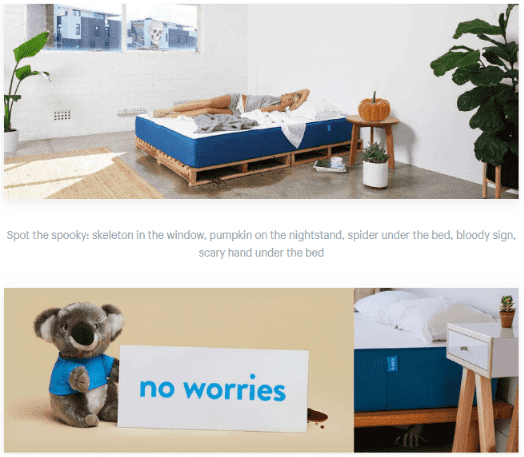
5. Koala Mattress Spot The Spooky

Koala Mattress made it to our iconic list because of their approach to generate halloween engagement. While most brands try to engage you through telling, Koala Mattress’s engagement approach is in getting their audience to play a game, that’s what we think it is.

Spook engagement during halloween with halloween marketing campaigns and take advantage of occasion-based marketing benefits.

Koala Mattress ask their audience to find the spooky elements in an image. Try finding out how many you can spot before scrolling to the end of the article for the answers.

6. Coke vs Pepsi

Coke and Pepsi are well known to be rivals and you must be wondering which made it to the iconic list. Some may say both, but we think Coke made it.

We mentioned earlier that brands often take a jab at their competitor and that’s what Pepsi’s Belgian ad agency tried with a daring creation. Note the “L” instead of “C” in coca-cola.

Spook engagement during halloween with halloween marketing campaigns and take advantage of occasion-based marketing benefits.

While it may not be a official response from Coke but from their fans, the Coke camp’s response was even more iconic based on their response to Pepsi.

What is unique in this advertisement is that there are many interpretations on Pepsi’s original ad. One of them is by wearing a Coke coat, Pepsi is trying to imply that it want to be like Coke. The debate is endless, but that might be Pepsi’s attempt to engage both camp of the cola wars.

7. Chipotle Booritos

The last brand that made it to the iconic list is a famous brand in the United States. Chipotle campaigns varies each year. However, they use the same approach of giving discounts to encourage customers to purchase a burrito and drive social media engagement. On some occasion, they may even turn stores into a halloween party.

Spook engagement during halloween with halloween marketing campaigns and take advantage of occasion-based marketing benefits.

You may be wondering why did Chipotle made the list since most other food and beverage chains are doing similar things. Chipotle difference is in their subtle approach to take a jab at their competitors. They do so by highlighting the additives their competitors use that consumers won’t find in Chipotle’s burritos. Chipotle goes another step further with a video encouraging their customers to dress in a costume with an ingredient that they thing is unnecessary.

Spot The Spooky Answers

Have you manage to find the spooky elements in the Koala Mattresses’ image? Find the answers below:

Spook engagement during halloween with halloween marketing campaigns and take advantage of occasion-based marketing benefits.

A final Note

It’s time to wrap things up and have a wild and crazy halloween! halloween could be a good time to engage in some “fun” or rather ghoulish advertising campaigns. A good digital marketing agency would be able to provide creative suggestions and integrate your campaign across all channels. In fact, MarketingGuru does not play tricks to generate results for our clients campaigns. Feel free to open the door to us and we may in turn give you a treat. Witch-ing you a spook-tacular Halloween!

The B2B Digital Marketing Strategy Roadmap To Maximize ROI

Understanding Digital Marketing Strategies

Digital transformation has overtaken the world in the past five years, changing the way we think, learn, inform, and buy. This change not only affects B2C businesses but it is making waves for those in B2B as well. Today’s wildly successful B2B brands have welcomed digital transformation into their marketing strategies and can be seen reaping the benefits. A stellar example comes in the form of HupSpot’s LinkedIn sonspored ads campaign that were meant to attract small to medium sized businesses. The results showed 400% more leads within their target audience. Other big B2B brands such as Shopify, Upwork and Dropbox are also leveraging the power of digital marketing to enhance their lead generation tactics.

Source: LinkedIn

While B2B marketing has always been challenging, today’s landscape gives birth to a whole new set of fast paced challenges that many B2B brands are struggling to catch up with. Technology has allowed B2B buyers to have unlimited access to information through multiple mobile devices at any time. This changes the buyer journey and opening up new channels of communication.

Navigating through this ever changing landscape can be a challenge – even for the best of brands. That is why we have compiled the ultimate roadmap to build a B2B digital marketing strategy that is fit to succeed in the modern B2B landscape. This B2B Digital Marketing Strategy roadmap that will maximize ROI and lead your B2B brand to maximise ROI.

If you would like to find out more on how to build a digital marketing strategy, head over to one of our article on digital marketing strategy.

Understanding Digital Marketing Strategies

The modern B2B buyer is much like a B2C consumer as their buying decisions are largely motivated by customer experience rather than the price. This requires B2B brands to take an experiential approach that leads the target audience through a digital journey to lifelong loyalty.

Despite these similarities, there are still some key differences. Read our the key differences between B2B and B2C Digital Marketing article to find out more.

The Roadmap Process Explained

Our B2B marketing strategy roadmap targets the five essential components of a successful digital marketing campaign. This includes website, SEO, social media marketing, content marketing and online advertisements. Read on to find out the importance of each one.

1.  A High Performance Website

Your website is much like a first impression for potential clients, making it the most valuable marketing asset. According to research, 80% of people examine websites in order to check out new service providers. These numbers are bound to rise as more millennials and Gen-Z buyers enter the market.

An effective website needs to have the right design, informative and relevant content that captures attention. Here are some main points to keep in mind while optimizing a website for lead generation and sales:

  • Ensure Fast Response Times: Eternally loading websites can be a huge turnoff. According to surveys, 40% users leave a website that takes more than 3 seconds to load.
  • Security Comes First: Unsecured sites are a big red flag for users and research suggests that 85% customers are averse to browsing an unsecured site. Avoid this by purchasing as SSL certificate for your website.
  • Make It Mobile Friendly:  In a world where 70% of all online traffic comes from mobile, a smooth mobile experience speaks for itself. Furthermore, 50% B2B queries originate from smartphones as buyers are more likely to choose vendors who have a mobile-friendly website experience.
  • Give Actionable Information: Your website is more than a long winded introduction to your services. It is a 24 hour sales opportunity which require actionable information like clear CTAs, contact forms, past projects, testimonials and affiliations to guide the buyer in the right direction.
  • Professional Design: Poor design and navigation capabilities repel buyers. Websites need to be pleasing to look at and easy to navigate. 
  • Get Your Message Across: 46% buyers abandon a website because it is not clear what the company does. Sometimes your message can get lost in the web design. Provide relevant content that highlights your core services so buyers don’t feel confused.

2.  SEO

Search Engine Optimization (SEO) is a growing field of interest that can generate leads and sales by really pushing your content and website forward. If you are unfamilar about SEO, head on to digest our 9 point simple SEO guide first. There are two primary components of SEO:

On-Site SEO helps search engines find your website through keyword phrases to produce relevant search results. These ensure that if B2B buyers are looking for your type of services, search engines can redirect them to your website or content.

Offsite SEO provides backlinks to your website in the form of outside engagement or guest appearances on other websites. Backlinks can increase your credibility and establish authority in the field while bringing in networking opportunities.

By networking, getting featured on other websites and generating more traffic, you can establish yourself as a credible source to get higher rankings on search engine results. SEO can be integrated into your content strategy to bring more visitors and put your company in the limelight.

3.  Content Marketing

Content marketing is a multi-dimensional area which consists of blogs, press releases, videos, social media content, articles, ebooks and much more. B2B buyers are increasingly relying on digital content to make their buying decisions easier. 75% B2B buyers think that content has a direct impact on their buying decisions.

Here are some content marketing areas that businesses are focusing on to get the best results.

  • Blog Posts: Blogs are a fantastic way to get your message across while providing helpful information and establishing your expertise. Buyers can gain insight on your work as they read relevant blogs that empathize with their problems and identify how to solve them. Blogs which connect to the buyers’ struggles and present it in an engaging manner are highly popular among B2B buyers.
  • Social Media Posts: Social media is an effective way to not only get customers but build an audience. Building an audience ensures that there are people who follow you for the content and remain loyal to keep coming back for you.
  • Infographics: Most people appreciate visual imagery as it can condense complicated information into an attractive visual. Infographics are the ideal way to present information and capture attention
  • E-books: E-books are also a content marketing strategy that is surprisingly effective when they include actionable information such as checklists, guides and tips that impart wisdom.

4.  Online Ads

Online ads may be the first thing that puts your company in the direct line of sight. Online ads can be in the form of text, imagery or videos displayed on frequently visited platforms such as Facebook, YouTube and other websites. These online ads have now become highly sophisticated to allow for targeted advertising that reaches the most relevant customers. Apart from contextual advertising, online ads target consumers even when they are distracted so they can recall your company without ever clicking or focusing on the actual ad.

Google advertising is a popular form of online advertising. The benefits of Google pay-per-click advertising should not be underestimated.

5.  Social Media Marketing

Social media has emerged as the ultimate tool for B2B marketing that can help in lead generation, branding, establishing authority and building an audience. Social media allows you to deliver a constant stream of targeted content that keeps your company relevant and entertains a loyal audience.

Here are some common types of social media posts that are most popular for businesses:

  • Blogs
  • Digital Seminars (webinars) or events
  • Attractive statistics and facts
  • Industry related news
  • Informative one minute videos

While a multi-channel approach is usually preferred, picking your social media platforms wisely can help you build a strategy for your type of business. All social media channels may not suit your brand but LinkedIn is a must for all B2B services. In fact, 80% of B2B leads originate from LinkedIn. So if you are a B2B business, having an active presence on LinkedIn is essential.

A Final Note

The digital world is an opportunity to start anew and target an even larger audience than ever before. As the world moves towards digital, sticking with the old approaches means risking your B2B business. Embrace the digital wave with a marketing strategy of your own through effective SEO, PPC and social media marketing that can take your B2B business to the next level.

Digital marketing strategies are all about innovation, so don’t be afraid to step out of the comfort zone and enhance the B2B buyer’s experience to maximize ROI and gain loyal customers. Use digital platforms to market your B2B agendas, learn from businesses and create new communication channels to help your business achieve greater heights.

Are you trying to build a B2B digital marketing strategy that works? MarketingGuru provide SEO, PPC and social media marketing services that can give your B2B business the desired competitive edge. Speak to one of our gurus today!

How To Build A Digital Marketing Strategy For Your Business?

Let’s face it. In today technological advanced world, every business has at least a website and some form of social media presence. What is more important is having an effective strategy to integrate all your digital assets.

What Is A Digital Marketing Strategy?

Whenever digital marketing is mentioned, SEO or PPC advertising are often among the first few jargon that comes to mind. For those who are not aware, they are acronyms for Search Engine Optimization and Pay-Per-Click advertising. However, many seldom mention and discus about establishing a digital marketing strategy.

“The series of actions that help you achieve your company goals through carefully selected online marketing channels. These channels include paid, earned, and owned media, and can all support a common campaign around a particular line of business.”

Digital Marketing Strategy
HubSpot Blog


According to HubSpot, digital marketing strategy “the series of actions that help you achieve your company goals through carefully selected online marketing channels. These channels include paid, earned, and owned media, and can all support a common campaign around a particular line of business”.

That’s a huge bunch of words. In short, it is simply how you are going to achieve your objectives by leveraging on your digital assets such as your website or social media accounts.

Why Your Business Needs A Digital Marketing Strategy?

Having mentioned that most business owns a website and a couple of social media accounts means that your competitors are also able to level the playing field. Hence, the only way to stay competitive is to have an effective digital marketing strategy to achieve your objectives.

Some may argue that there are other forms of marketing and digital marketing is just one of them. That may be true, but digital advertising spending is set to overtake traditional in the United States. This underscore the importance of not only having a credible brand image but also the strategy.

The trend in many small and mid-market companies is to outsource various areas of web development, marketing and graphic design to agencies. This fact makes it more important to understand your own strategy. A digital marketing strategy not only convey a unified message to your audience but also helps to establish a reliable brand image.

How To Develop Your Own Digital Marketing Strategy?

For those not in the marketing industry, it may seem like an uphill battle to craft a digital marketing strategy. Don’t let the word ‘strategy’ scare you off. The steps outline in this article can be applied for both large and small companies.

Step 1: Identify your objective and goals

This step should be obvious since nailing down your objectives and goals will help you determine how your digital marketing objective contribute to your overall business objectives. For example, if the business objective is to increase revenue by 50%, your digital marketing goal would possibly be to increase leads from your website by at least 50%. By having a quantitative goal, it helps to determine the best tactics to be successful.

Step 2: Analyze your past campaigns

Chances are that your business has done a digital campaign previously. By identifying the past mistakes and results, it can provide useful insights and help focus the marketing resources.  Based on the insights, you may need to revisit step 1 and change your goal.

For instance, after analyzing your leads from your digital assets, you discover that most came from Facebook. Hence, you may want to focus on a KPI regarding Facebook such as increasing Facebook followers by 30%.

Step 3: Identify your target audience persona

Every business will not be profitable without their customers. Hence, it is of utmost importance for a business to know their key customer groups and their profile. This includes identifying their demographic and psychographics attributes. A simple way to build your audience persona is to take a look at your Google Analytics’ Audience Reports and identify the key characteristics such as age, sex, career, etc.

Step 4: Identify your means

At this junction, it is important to identify three aspect: budget, digital channels and your team. It is important to determine if you have the required budget need to achieve your goals. This could be done by using historical data of your past campaigns to create a forecast of the results. Most importantly, you should also allocate your budget to each channel you intend to use.

This is also the best time to do an audit of your digital channels. You may want to focus more on a certain channel or even explore new channels you haven’t explored in the past. You may also want to evaluate if A/B testing should be implemented for certain channels. If KPI has not been set for each individual channel, it may also be a good time to do so.

The last aspect is your own team. You should assess and evaluate if your team possess the capacity and expertise to execute your digital marketing initiative. This is also the time to determine if you should hire more team members or to outsource certain elements to an agency.

Step 5: Develop, execute and review the plan

After all the research and evaluation, it is time to put everything into the plan. Certain elements may have to be achieved first before others can begin, just like your website has to be completed before beginning SEO and thereafter, social media marketing. This may require a certain degree of expertise and coordination and should be best left to a professional agency if your team is small or does not possess the required capabilities.

Don’t be surprised if your plan is not executed successfully because not all assumptions will be correct. The key in this step is to regularly review the performance and tweak the necessary elements as needed. At regular intervals, ideally on an annual basis, scrutinize the performance and do a complete review. If necessary, don’t be afraid to go back to Step 1 and repeat the process.

A Final Note

Digital marketing may seem easy. After all, most millennials are already savvy with social media and you probably use Google as the starting point when looking for products. However, crafting a digital strategy and reviewing it regularly may not be that easy since most marketers also have other tasks. This is when consulting a full-service agency really helps. You may even consider outsourcing your marketing department and focus on your strengths to develop your business. If your business has not started or is in the process of developing your digital marketing strategy, contact MarketingGuru to find out how we can help you today.

4 Key Differences Between B2C and B2B Digital Marketing

Gone are the days when being found online is a good-to-have. Today, your business existence lies on being found online. This makes digital marketing a crucial tool in any marketer’s toolbox and being able to understand the difference between B2C and B2B digital marketing is essential for an effective campaign. Before we begin, let’s find out what is B2C and B2B.

B2C vs B2B

B2C and B2B are simply the two different main types of customer transactions. Often times, many people confuse the ‘C’ in B2C to refer to customers. They are correct in some sense, but technically, they are wrong. B2C and B2B refers to business-to-consumer and business-to-business respectively. Their similarity lies in that both consumers and businesses are customers. In short, B2B end-customers are businesses while B2C end-customers are consumers who are the general public.

Most business are a mix of B2C and B2B so as to maximize their potential revenue. A good example is your local banks. They have products and services that target the general public (B2C) and very likely also have another business division catering to companies by providing slightly different products and services (B2B).

Now that we know what B2C and B2B, we can begin looking at their differences.

1. Audience Buying Process

The audience buying process involves two components: the audience and their respective buying process. We know B2C and B2B audience are different because their end-customers are different. Because of this, the market size for B2C and B2B are different. B2C companies have a larger market size because their market involves everyone (before segmentation). B2C customers also are quicker to decide because they can make the final decision.

B2B transactions on the other end take longer. This is because there may be many layers of hierarchy to seek approval. The marketing executive may have to seek approval from his manager who then need to seek approval from his director. Closing a B2B deal may take many weeks or even months.

2. Campaign Goals

With different audiences and sales cycles, the campaign goals are also definitely different. Hence, it is not logical for both to have the same objectives. For B2C, the goal is to get as much traffic to the website or landing page as possible. This is because consumers tend to make quicker decisions, it is possible for consumers to make a purchase on the first visit to the website. Think about how often you enter an e-commerce website and make a purchase before you leave the website.

With slower sales cycle and longer buying process, the goal of B2B campaigns is to reach the correct and qualified person. If the decision maker is the marketing director, there is no point in targeting the human resource executive who does not need your products. B2B can also be seen as playing the long game because it is not enough to just create awareness to your target audience. The long buying processes require constant efforts to remind the decision makers and that involve re-targeting.

3. Keyword Optimization

Different audiences also mean different keywords are used when searching for products. B2C keywords are also more competitive because of a larger market and also because they are more generic. Whereas, B2B keywords are more niche to their industry and may not be as competitive.

Both B2C and B2B also have their own challenges in keyword research. The challenge for B2C keyword research is in finding keywords that are not too saturated but still have a decent traffic level. B2B challenge is in finding keywords that are technical but not too niche and still informative to all who are involved in the buyer’s journey.

4. Content Strategy

Content is a big topic and content can exist in countless formats. The content strategy here would refer to the approach B2C and B2B uses to attract their audience to their website or landing page. As mentioned, B2C buying process is quick and the objective is to get the most conversions in a short period of time. Hence, the content focus on flashy promotions or to a certain extend click-bait. You may have notice that your favorite retail brand often attracts you using sales promotion. Most of the time, the promoted discount is not applicable on your desired product.

B2C content strategy is less effective for B2B. Due to longer buying process, the content focus is on providing informational and valuable content to the user. This is to assist their buyer journey to help making a decision on choosing their product or service. Since B2B target audience are normally not found at where B2C audience normally hang out, you will seldom see their social Ads on Facebook or Instagram. B2B focus would be on customer case studies or white papers.

A Final Note

B2C and B2B digital marketing strategy are very different and require different approach. B2C may see more immediate results which make B2B seems like more work. However, B2B sales tends to be of higher monetary value and a single deal may be worth the entire B2C revenue of the quarter. There are benefits to both B2C and B2B but what is important is knowing the difference. It may make sense to outsource your marketing needs if you don’t possess the relevant expertise. Whether it is B2C or B2B Digital Marketing, contact MarketingGuru to find out how we can improve your marketing results.